HUB24 Review: Is It Any Good, or Just A Rip Off Machine?
By Andy Darroch, independent financial adviser. Updated 29 September 2026.
The short answer: HUB24 is a superb business (rip off machine) and a terrible place for your super. Over the last ten financial years, HUB24 Super Fund members earned 4.3% a year, on APRA's own numbers. The low-cost industry funds I recommend earned 7.3% after investment fees, matched for asset allocation and pension/super mix. HUB24 lost in eight of those ten years.
If an adviser has recommended it, my experience is that the recommendation is about their fee: the wrap lets them draw an ongoing fee from your balance, every month, in a way an industry funds won't allow. Read the advice with that in mind. That’s my opinion.
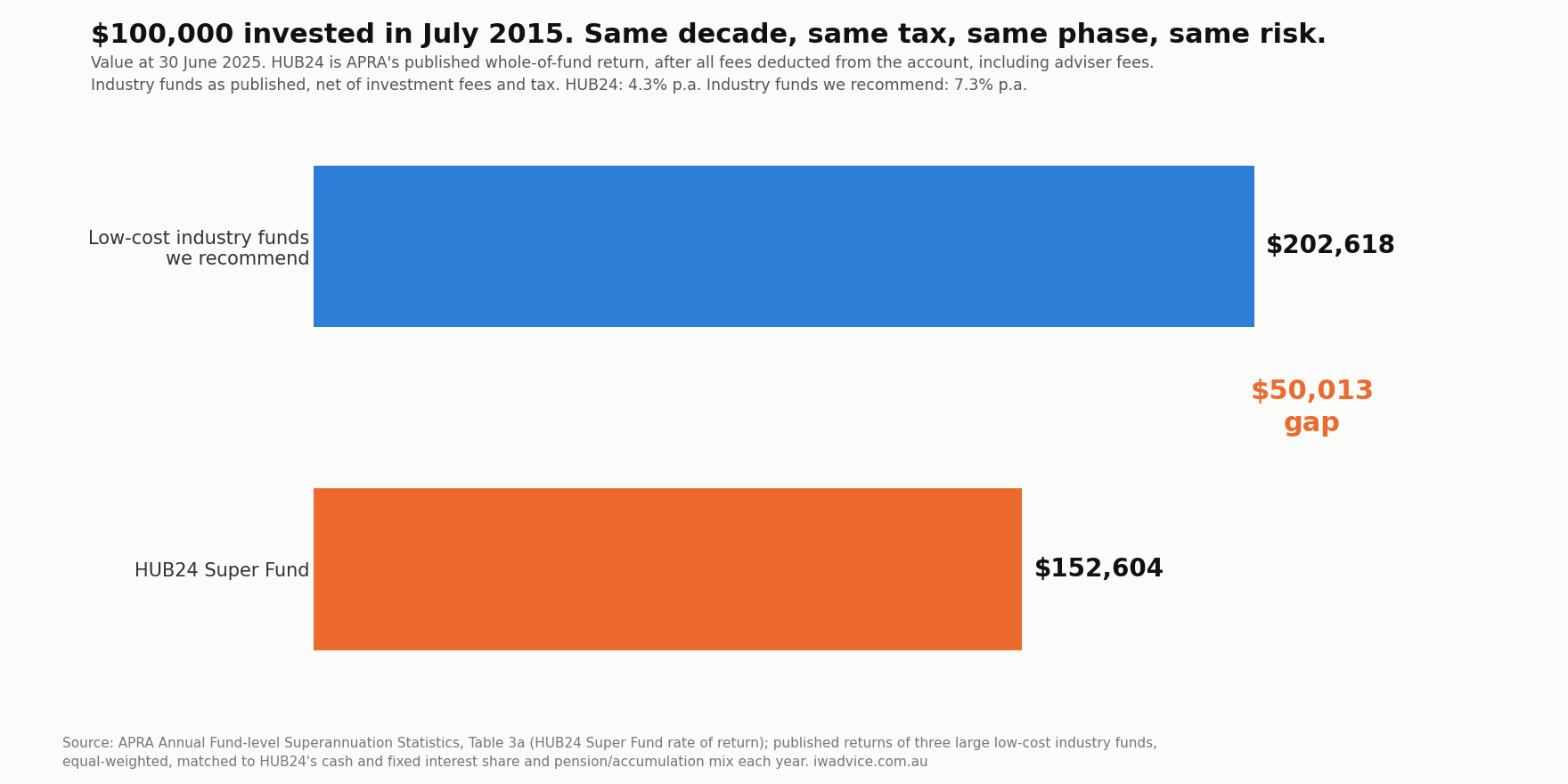
$100,000 invested 1 July 2015, value at 30 June 2025. HUB24 return as published by APRA, after adviser and administration fees; industry funds before administration fees. Past performance is not a reliable indicator of future performance.
If you're reading this, one of two things has happened. Either a financial adviser has handed you a Statement of Advice recommending you roll your super into HUB24, or you already did, and you’re wondering…. Are you getting ripped off?
I know this because wrap platforms like Hub24, are sold, not bought. No one in history has ever woken up and thought, my god do I feel like an Investor Directed Portfolio Service today!!!!
Either way, good news for you, and bad news for me. I've read HUB24's audited financial statements back to 2014, every APRA dataset that mentions them, far more than the world health organisation’s recommended dosages. Here is what they say.
What is HUB24? (Hint: A colossal waste of your money)
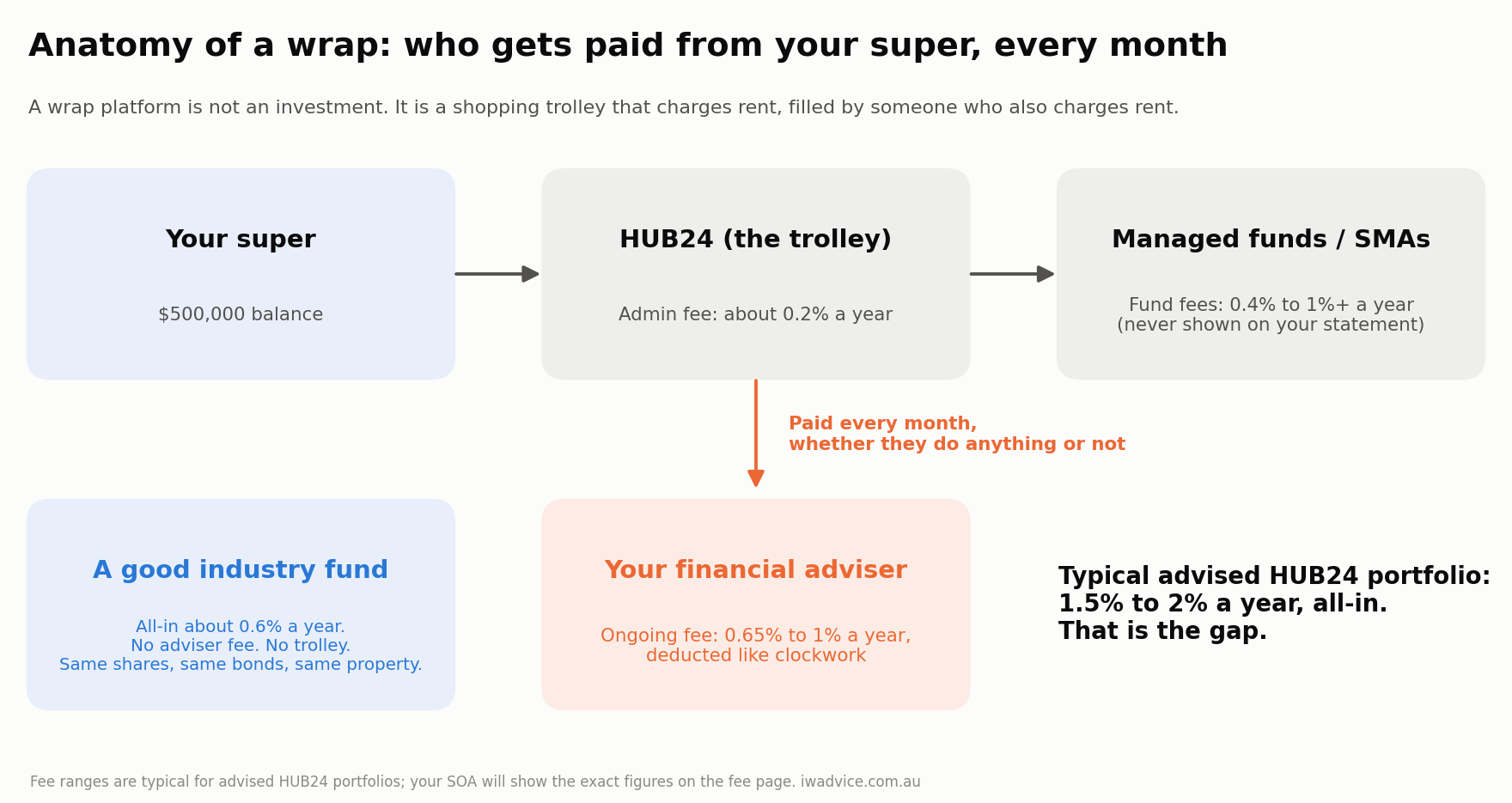
HUB24 is a wrap platform. A wrap is an administration service that lets an adviser hold your super, managed funds, shares, ETFs and cash in one account, charge fees against it, and report on it. It is not an investment. It is a shopping trolley. What goes in the trolley is up to the adviser, and the trolley charges rent, aggressive rent. They also control what’s on the shelves.
Wraps are also called "adviser funds", which is the honest name. Netwealth, HUB24, Macquarie Wrap, AMP MyNorth, CFS Edge, Centric, Praemium, Dash: different logos, one purpose. They exist to pay ongoing fees to financial planners. That is the product.
HUB24 Limited (ASX: HUB) runs the platform. The HUB24 Super Fund is the super product, with Equity Trustees as trustee. At 30 June 2025 it held $48.5 billion across roughly 186,000 accounts and is growing faster than anything else in super. There’s far more in the Hub24 product that operates for SMSFs and investment accounts. That tells you how easy it is to sell, not how good it is to own.
One habit worth forming before you read on: every time you see the word "adviser" in your Statement of Advice, substitute "salesperson". The document will make a great deal more sense.
Is HUB24 a good super fund? (Hint: No!)
Depends who's asking.
If you're a Hub24 shareholder: Yes! It’s magnificent, buy more please. If you’re the adviser getting paid huge cushy fees for doing absolutely no work, my god yes! The very best!
If you're a member and it’s your money: No. They are horrendous.
To show this, here is the HUB24 Super Fund's whole-of-fund return as published by APRA, against a composite of the low-cost industry funds we recommend, blended for the same asset allocation and pension/accumulation mix HUB24 has each year. Same tax, same phase, same decade.
No two HUB24 members hold the same portfolio, so this is the pooled result of all of them: some did better, some did worse. That's the only whole-of-platform figure that exists, and it's the number HUB24 itself reports to APRA. I have recalculated it from HUB24's audited accounts and get the same result within 0.2% in nine of ten years, and exactly the same in FY2024.
| Financial year | HUB24 Super Fund | Industry funds we recommend | Gap |
|---|---|---|---|
| FY2016 | 0.7% | 5.6% | -4.9 |
| FY2017 | 4.5% | 8.8% | -4.3 |
| FY2018 | 5.3% | 8.8% | -3.5 |
| FY2019 | 5.7% | 8.7% | -3.0 |
| FY2020 | -2.9% | 0.0% | -2.9 |
| FY2021 | 14.0% | 17.5% | -3.5 |
| FY2022 | -8.1% | -1.4% | -6.7 |
| FY2023 | 8.0% | 7.9% | +0.1 |
| FY2024 | 8.7% | 8.4% | +0.3 |
| FY2025 | 9.1% | 9.9% | -0.8 |
| Ten years, p.a. | 4.3% | 7.3% | -3.0 |
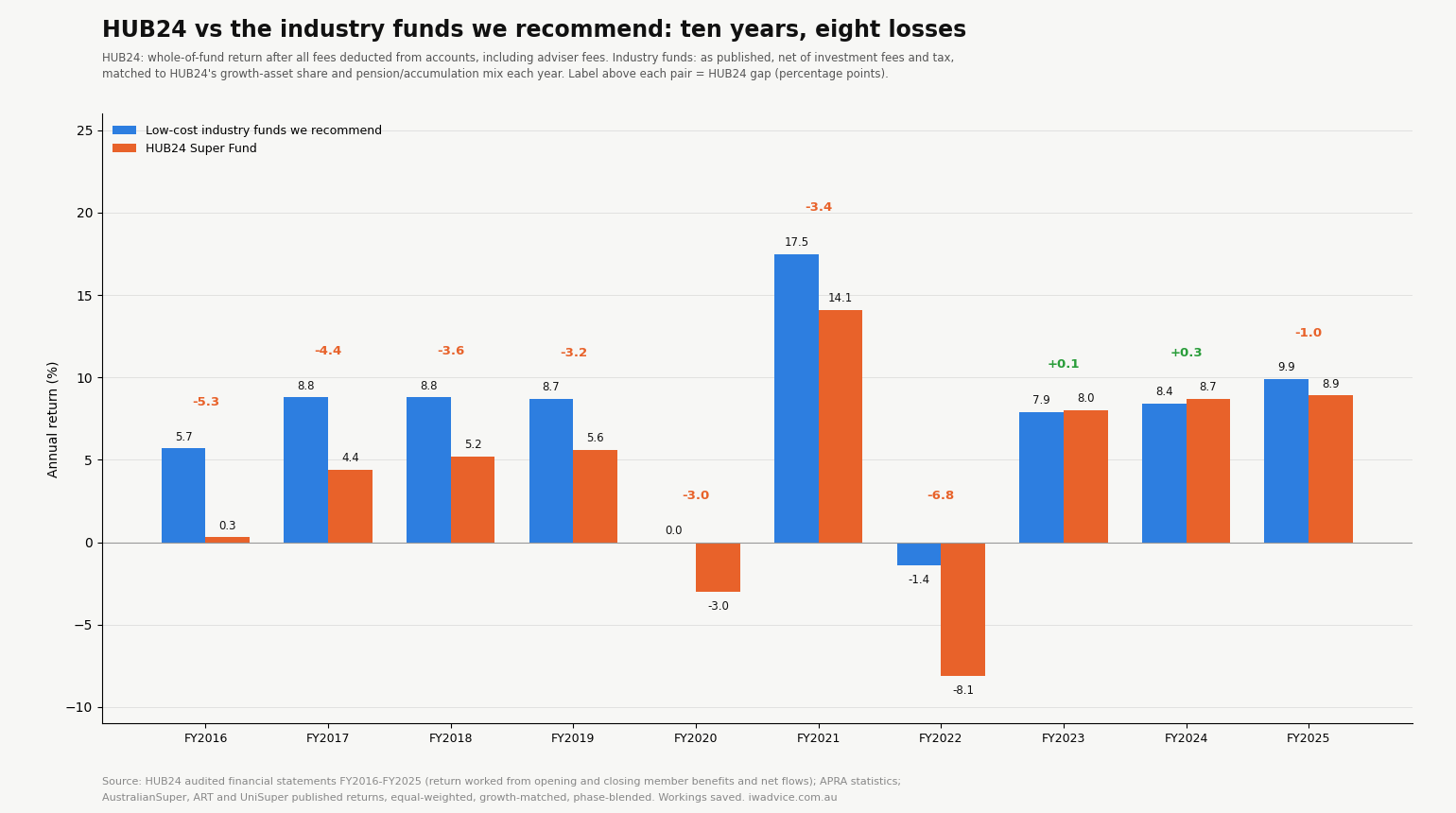
Past performance is not a reliable indicator of future performance.
HUB24 figures are APRA's published whole-of-fund rate of return, after administration and adviser fees. Industry figures are each fund's published option returns, net of investment fees and tax, before administration fees, matched to HUB24's asset mix and pension share each year.$100,000 in HUB24 Super in July 2015 became $152,604. The same money in the industry funds we recommend became $202,618. That is $50,000 the industry funds made you that HUB24 didn't, after the ongoing adviser fee, which HUB24 deducts from your account and reports in its own accounts as a $314 million line item (more on that shortly).
Ten years. Eight losses. HUB24 members, in aggregate, have beaten a risk-matched blend of the good industry funds in two financial years, by 0.1 and 0.3 of a percent. The difference between HUB24's actual result and that benchmark over the decade, in dollars: about $2.2 billion. That's not a bad year. That's a business model.
HUB24 will say the comparison is unfair because a wrap's whole-of-fund return blends every member's portfolio and holds a bit less in growth assets. Fine. The table above already matches HUB24's own growth-asset share and pension mix, fund by fund, year by year. Drop the matching and put it against a plain default Balanced option instead, and it loses ten years out of ten, by 4% a year. Match the risk however you like. The gap doesn't close, because the gap isn't risk. The gap is what advisers put in the trolley, and what they charge for it.
Why does this keep happening? The mechanic and the car company
You're buying a car.
Option one: any car you want, straight from the manufacturer, you can choose the colour!
Option two: your local mechanic offers to design and build you one from scratch, so you have "control".
Who builds a better car? A suburban mechanic, or a multinational company with decades of experience, thousands of engineers, advanced manufacturing processes and a proven track record? I like my mechanic, I also have a motorbike mechanic, and I like him as well. I don't need him to build my car, because he cannot compete with Toyota, or BMW, or BYD as it turns out.
A big industry fund is the car company. It runs hundreds of billions, employs investment teams by the hundred, and gets access and pricing from global managers that you cannot buy at retail. I once took the broadest wrap investment menu I could find, about 800 funds, and cross-checked it against the managers inside one industry fund's Balanced option. Most of those managers weren't on the wrap at all. Not the fund, the manager. A $200 billion fund gets a seat at tables your adviser doesn't know exist.
Industry funds are selling you fine champagne and caviar at McDonalds’ prices and advisers are selling you 6 day old Chiko Rolls at fine dining restaurant prices, and they’re taking two bites out of it before they hand it to you.
A HUB24 portfolio is the mechanic's car. Assembled in a suburban office by someone who is, at best, a talented amateur at portfolio construction, from parts the real manufacturers won't sell them. And you pay more for it. Every month. Forever.
HUB24 fees explained (admin, investment, advice)
Fees deducted from HUB24 Super Fund member accounts, from the audited statements:
| Financial year | Admin | Investment | Advice fees paid to advisers | Total | Total as % of year-end assets |
|---|---|---|---|---|---|
| FY2021 | $33m | $19m | $100m | $152m | 1.14% |
| FY2023 | $57m | $36m | $190m | $284m | 1.14% |
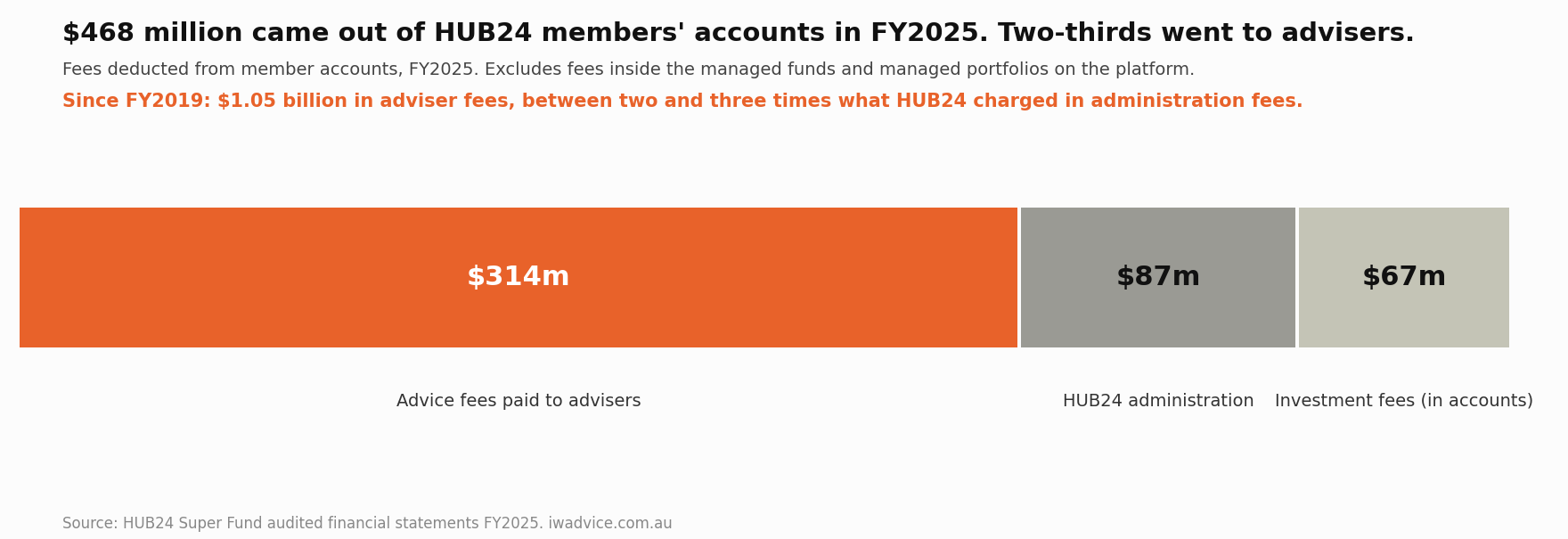
| FY2025 | $87m | $67m | $314m | $468m | 0.96% |
Read the advice column again.
Since FY2019, $1.05 billion in ongoing adviser fees has come out of HUB24 member accounts. That is between two and three times what HUB24 itself charged in administration fees to run the thing. The platform is not the product. The platform is the pipe, and your adviser's ongoing fee is what flows through it: deducted every month like clockwork, whether your adviser is working, useless, talented, smart, dumb or asleep. An industry fund won't let them plumb that pipe, which is the entire reason you're being asked to leave one. Some of that $314 million bought advice that was worth having. The point is that the fee comes out either way, and the platform is built so it can.
$314m in FY25, is $3m less than Coopers Brewery! That is insane! Coopers are a brilliant product and provide a medically necessary service!
Adelaide airport had $332m of total income in FY25. And this is just a fraction of Hub24’s assets.
The table also excludes the fees inside the managed funds and managed portfolios on the platform, because those are netted out of the unit price before the accounts ever see them. Add those in and a typical advised HUB24 portfolio costs about 1.7% a year all-in: 0.76% adviser fees and 0.21% administration, both from the FY2025 accounts as a share of average assets, plus an estimated 0.7% inside the managed portfolios and underlying funds, weighted from the December 2025 portfolio holdings disclosure. A good industry fund Balanced option is around 0.6%.
Does 1% matter? Over ten years it's 9% of your balance. Over twenty, 17%. At 3% a year, roughly where HUB24 has actually sat against the funds we recommend, you lose a quarter of your super in a decade and 43% over twenty years. Nobody notices, because the balance still goes up. It just goes up by less, forever, and the difference is somebody else's boat.
| HUB24 Super | Low-cost industry funds we recommend | |
|---|---|---|
| Ten-year return p.a. (FY16 to FY25) | 4.3% | 7.3% |
| Years beaten the other | 2 of 10 | 8 of 10 |
| Growth-matched benchmark | Trails by 3.0% p.a. | 0 of 10 years |
| Who builds the portfolio | The mechanic | The car company |
| Ongoing adviser fee | Yes, monthly, from your balance | No |
| What happens if you sack the adviser | You keep a HUB24 account and no idea what is in it | Nothing. It keeps running |
That last row is the quiet genius of the wrap model. Put someone in an industry fund and they can leave you tomorrow and lose nothing. Put someone in a wrap full of managed portfolios and they cannot leave without another adviser to unpick it. A portfolio you can't evaluate is a portfolio you can't leave, and that, not performance, is what the platform is built for.
Is HUB24 safe?
Yes. Let's be clear about this, because Reddit isn't. Your assets sit with a custodian, Equity Trustees is the trustee, HUB24 is ASX-listed, APRA-regulated and profitable. Nobody is going to run off with your money.
The risk is not theft. The risk is slow, compliant, fully disclosed, entirely legal underperformance, signed off by you on page 47 of a Statement of Advice you didn't read. A lot of people are told, or made to feel, that leaving an industry fund protects their super from the finance industry. By moving to a wrap you do the exact opposite: you hand the finance industry a key to your account and a standing order to pay itself.
HUB24 rollovers
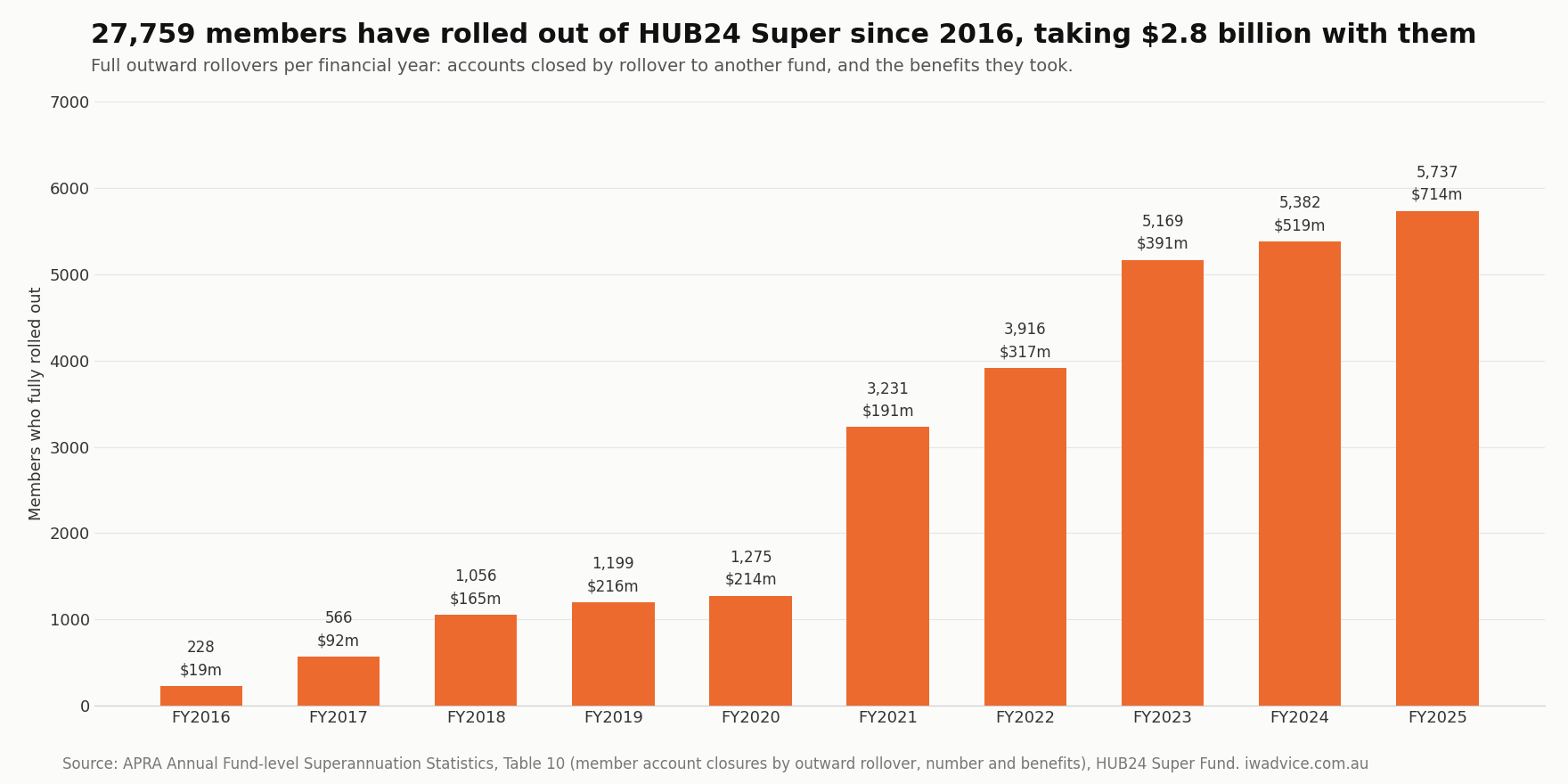
You will read alot in the press about how many ‘inflows’ i.e. people rolling money into Hub24. But it pays to consider those that rollout. APRA data show that in FY2025, 5,737 members left HUB24 Super via full rollover, taking $714 million with them. Over ten years, 27,759 members have fully rolled out, taking with them some $2.8 billion.
Bear in mind that virtually every HUB24 member has a financial adviser with a vested interest in that member keeping the account. APRA's data doesn't say why people leave, and I won't guess. Some will be consolidating, some moving to an SMSF, some moving to another wrap. But every one of those 27,759 rollovers happened against the pull of an adviser being paid to keep them there.
The most common thing I’ve heard from clients with wrap accounts, is simple: "I don't know what I'm paying, I don't know what I'm invested in, and I can't tell if I'm doing well." I don’t think that’s a bug, it’s the design.
Can you use HUB24 without a financial adviser?
Technically, through some direct channels, yes. Practically, HUB24 is an adviser product: the pricing, the menu and the whole design assume someone is being paid to sit between you and it. If you're the sort of person who'd run it yourself, you're the sort of person who should be in a low-cost index option in an industry fund, or an ETF portfolio, and getting on with your life.
Who is HUB24 actually right for?
Honestly, pretty much no one. A narrow group. By narrow group, maybe a few thousand in the whole country. People with genuinely complex holdings (large direct share portfolios with embedded capital gains, unusual assets, estate structures) who need consolidated reporting and are happy to pay for it with open eyes.
For the 35-year-old engineer, the 52-year-old nurse, the couple with $900,000 between them heading into retirement: no. Your investment needs are not bespoke, whatever the SOA says. Everyone falls into a bucket. You need a high-quality, diversified, low-fee portfolio that leaks the least in tax, and an industry fund already built you one. You're being asked to leave it so someone can clip 0.65% a year for the privilege of building a worse one.
What to do with the SOA in your hand
Don't sign it yet.
Every Statement of Advice recommending HUB24 that has crossed my desk was written by someone who gets paid, every month, for as long as you stay. That is not a reason to assume the advice is wrong. It is a reason to get advice from someone who doesn't.
That's what I do. Independent Wealth Advice is a flat-fee, fully independent firm. No commissions, no ongoing fees, no platform payments, no wraps. You pay once, for advice, the way you'd pay a lawyer or a surgeon. I'd make ten times as much running the standard model. I'd rather sleep.
Book an Initial Consultation. $330, 45 minutes, on Teams/Zoom.
The consultation is the start of getting proper advice. On the call I'll tell you whether you need advice at all, what it would cover, and what it costs. Some people need a full Statement of Advice. Some people need to be told they're fine where they are, and they leave with that. The $330 is credited in full against the advice fee if you proceed.
I take four consultations a week and no more. If the booking page shows nothing this week, that's why.
Frequently asked questions
Is HUB24 a good superannuation fund?
No. It’s a rip off machine.
HUB24 Super Fund's whole-of-fund return, as published by APRA, trailed a composite of the low-cost industry funds we recommend in eight of ten financial years from FY2016 to FY2025: 4.3% a year versus 7.3%. For shareholders it has been excellent.
What is HUB24?
A wrap platform, sometimes called an adviser fund: an administration service that holds your super and investments in one account so an adviser can manage, report on, and charge fees against them. It is not an investment.
Who owns HUB24?
HUB24 Limited, listed on the ASX (ticker HUB). The trustee of the HUB24 Super Fund is Equity Trustees Superannuation Limited.
Is HUB24 safe?
Yes. APRA-regulated, custodially held, ASX-listed and profitable. The risk with HUB24 is underperformance and fees, not losing your capital.
What are HUB24's fees?
In FY2025, $468 million was deducted from member accounts: $87 million administration, $67 million investment and $314 million in adviser fees, about 0.96% of assets before the fees inside the underlying funds. A typical advised HUB24 portfolio costs about 1.7% a year all-in.
Is HUB24 a super fund or a platform?
Both. HUB24 is the platform; the HUB24 Super Fund is the super product that sits on it.
Can I use HUB24 without a financial adviser?
In limited cases, but it's priced and built for advised clients. A self-directed investor is better off in an industry fund index option or an ETF portfolio.
Where does HUB24 rank in Australia?
By inflows, near the top of every platform league table. By member returns, behind the major industry fund Balanced options for ten consecutive years.
My adviser recommended HUB24. What should I do?
Get advice from someone who isn't paid if you sign. Book an Initial Consultation above.
Updated 25 September 2026: removed a section comparing Netwealth, which I hadn't shown the numbers for; rebuilt the industry composite from a saved workbook, which moved its ten-year return from 7.1% to 7.3% and HUB24's record from one win in ten years to two; switched the HUB24 return to APRA's published whole-of-fund figure (4.3% a year) in place of my own calculation from the audited accounts (4.2%), which it matches within 0.2% in nine of ten years; corrected the HUB24 account count and the ratio of adviser fees to platform fees; revised foregone earnings from $2.6 billion to $2.2 billion and moved it to an average-assets basis; clarified the basis of the HUB24 return; replaced the estimated all-in cost with a sourced figure; removed a summary table row and an infographic that said HUB24 portfolios cannot hold unlisted infrastructure, private equity or private credit, which was wrong; the point is that most managers used by the big industry funds are not on the platform menu. Updated 29 September 2026: corrected the rollover figures to APRA Table 10 (accounts closed by full rollover and their benefits), $714 million in FY2025 and $2.8 billion over ten years, in place of total transfers out of the fund; corrected the trustee name to HTFS Nominees Pty Ltd, an Equity Trustees group company; added a worked example and fee, rollover and compounding notes to the methodology.
How the figures are calculated:
HUB24 return. APRA's published whole-of-fund rate of return for the HUB24 Super Fund, from the Annual Fund-level Superannuation Statistics (Table 3a), for each year ended 30 June, FY2016 to FY2025. It is the return credited to members after administration fees, adviser fees and tax, across every HUB24 Super member's portfolio pooled together. It is not the return of any one investment option or any one member. As a check, I recalculated the same return from HUB24's audited financial statements: the amount credited to members' accounts for the year divided by the money members had in the fund, with contributions and withdrawals assumed to arrive evenly through the year (the Modified Dietz method). The recalculation is within 0.2 percentage points of APRA's figure in nine of ten years and identical in FY2024 (8.7%); FY2016 differs by 0.4 points because those accounts are in an older format. APRA's figure is fractionally higher than my calculation in most years, so using it does not overstate the gap.
Industry composite. An equal-weighted average of three large, low-cost industry funds. Balanced returns are the funds' own published financial-year figures. Conservative Balanced returns are APRA's quarterly product statistics compounded to financial years; where a fund publishes both, the APRA series reproduces the fund's own Balanced figure to within 0.1 percentage points.
Asset allocation matching. HUB24 members, in aggregate, hold more cash and fixed interest than a standard Balanced option. So for each fund and each year, the Balanced and Conservative Balanced options are blended in the proportion that gives the same cash plus fixed interest share as HUB24 had that year. HUB24's allocation comes from its annual report; each option's allocation comes from APRA's published strategic asset allocation at 30 June. The benchmark therefore carries HUB24's own level of cash and fixed interest every year, not a fixed Balanced allocation. Property, infrastructure and alternatives are treated as growth assets throughout.
Pension and accumulation matching. Pension accounts pay no tax on earnings, so their returns are higher. Each option's return is blended between its accumulation return and its pension return using the share of HUB24's assets that were in pension phase that year (APRA Table 11). The benchmark therefore carries HUB24's own tax position every year.
Worked example, FY2025. HUB24 held 33% in cash and fixed interest and 38% of assets in pension phase. For the first of the three funds: Balanced option 23.5% cash and fixed interest, Conservative Balanced 43.8%, so the blend is 47% Conservative Balanced; accumulation and pension returns blended 62/38 give 9.4%. The same steps give 10.2% and 10.0% for the other two. Composite 9.9%. HUB24 per APRA Table 3a: 9.1%.
Basis of comparison. HUB24's return is after administration fees, adviser fees and tax. Industry fund option returns are after investment fees and tax but before administration fees, which is the basis on which those funds publish them. Industry fund administration fees are typically 0.1% to 0.2% a year and would reduce the industry figures by roughly that amount. HUB24 adviser fees were 0.6% to 0.8% of assets a year over the period; adding them back would lift HUB24's ten-year return from 4.3% to about 5.3% a year, still below the composite.
Dollar figures. The $100,000 illustration compounds each year's return from 1 July 2015 to 30 June 2025, with no contributions or withdrawals. Foregone earnings are each year's gap multiplied by the average of HUB24's net assets at the start and end of that year, summed over ten years. This is a simple sum, not compounded. If each year's shortfall had stayed invested at the composite return to 30 June 2025, the total would be about $3.0 billion rather than $2.2 billion.
Fees. The fee table shows fees deducted from member accounts per the audited statements, as a percentage of year-end net assets. The 0.76% adviser and 0.21% administration figures are the same FY2025 fees as a percentage of average net assets. The roughly 0.7% inside managed portfolios and underlying funds is an estimate, weighted from HUB24 Super's December 2025 portfolio holdings disclosure and the platform investment menu.
Rollovers. Members who fully rolled out and the dollars they took are from APRA Table 10 (member account closures by outward rollover, number and benefits). These count only accounts that were closed by a rollover to another fund; partial rollovers from accounts that stayed open are excluded.
Limitations. One of the three funds did not publish a Conservative Balanced return before FY2023 or an APRA strategic allocation before June 2022; for those years its figures use the average relationship between Balanced and Conservative Balanced at the other two funds. All figures are rounded.
Past performance is not a reliable indicator of future performance. This is general information only. It does not take into account your objectives, financial situation or needs. Consider whether it is appropriate for you and read the relevant Product Disclosure Statement and Target Market Determination before making any decision.
Sources: HUB24 Super Fund audited financial statements FY2014 to FY2025; APRA fund-level and product statistics; the published returns of three preferred industry funds, averaged, blended between each fund's Balanced and Conservative Balanced options to match HUB24's growth-asset share, and adjusted to match the mix of pension and accumulation members HUB24 has each year. HUB24's returns are APRA's published whole-of-fund rate of return: a dollar-weighted aggregate across all members, after administration and adviser fees. I have recalculated them from HUB24's own audited accounts (what the fund started the year with, what it finished with, and the money that came in and went out in between) and get the same result within 0.2% in nine of ten years, and exactly the same in FY2024. The industry fund figures are the funds' published option returns, net of investment fees and tax, before administration fees. Andy Darroch is Director of Independent Wealth Advice Pty Ltd, a Corporate Authorised Representative of Independent Financial Advisors & Media Pty Ltd (AFSL 550651), a flat-fee independent adviser. He receives no commissions.
General advice warning: this article is general advice only and reflects my professional opinion. It has been prepared without taking into account your objectives, financial situation or needs. Before acting on it you should consider whether it is appropriate for you, read the Product Disclosure Statement and Target Market Determination for any product mentioned, and seek personal advice from a licensed financial adviser. Nothing here is a recommendation to leave, join or stay in any particular fund. Past performance is not a reliable indicator of future performance. Figures are drawn from the sources listed above and are accurate to the best of my knowledge as at the update date; if you find an error, tell me and I'll correct it.